

Seated atop a three-wheeled chair with large, rugged tires, bicycle-style handlebars, and robotic footrests, wheelchair pilot Dr. Jaimie Borisoff waits patiently for the race to begin. Sporting a yellow helmet and supported by a team of coaches and spotters, he has eight minutes to complete 10 challenges that lie on the obstacle course ahead of him.
A clock next to the start line counts down the seconds until the race begins. “Five… four… three… two… one… GO!” calls out a race official, waving a green flag to start the race.
Borisoff expertly navigates the wheelchair, nicknamed the “BEAST” (BCIT Extending Articulating Wheelchair for Serious Terrains), up and down staircases, around tables and objects, and over uneven terrain and doorsteps. Along the way, he elevates the chair to reach an object above sitting height, uses the chair to pick up a bottle off the ground and place it on a table, and opens, passes through, and closes a door with a different door handle on each side—without touching the door with his hands.
The stands erupt in applause as Borisoff crosses the finish line, having successfully completed all 10 challenges in a record six minutes and 17 seconds.
After nine months of rigorous engineering, testing, and training to develop a high performance wheelchair with advanced capabilities, Borisoff and the British Columbia Institute of Technology (BCIT) MAKE+ team travelled more than 8,300 km to compete in the wheelchair race at the 2024 CYBATHLON, an international competition that challenges participants to develop assistive technologies for people with disabilities. The competition took place from October 25-27, 2024 in Zurich, Switzerland.
Scoring a perfect 100 points, the BCIT MAKE+ team was the only Canadian team to secure a gold medal at the 2024 CYBATHLON. “We were happy. Our goal was to do all 10 tasks under eight minutes, and we did that. Turns out that was a win, so that was exciting,” says Borisoff, who has been a wheelchair user since sustaining an SCI more than 30 years ago.

A Research Showcase and a Competition
Borisoff is the Director of BCIT MAKE+, a group of multidisciplinary researchers focused on product development, evaluation, applied research projects, and education. Borisoff is also the former Canada Research Chair in Rehabilitation Engineering Design, with an extensive program of research focused on how technology development can improve accessibility and mobility for people with SCI.
“It’s interesting when you go into it because… [the CYBATHLON] is a combination of a scientific conference plus the Paralympics,” explains Borisoff. “It has elements of both where you have people showcasing the research they’re doing and then it truly is a competition. So, it helps to go into it with a competitive mindset.”
As a four-time Paralympian and three-time Paralympic medallist who spent 13 years on Canada’s national wheelchair basketball team, Borisoff is no stranger to the pressures of competition. But his first priority was to share some of the innovative wheelchair technologies that the MAKE+ team has been working on in recent years.
“One of the reasons we wanted to go to the CYBATHLON was to showcase the work we do at BCIT MAKE+,” he says. “We have a long history in our lab of wheelchair research and development…[We are working on] how to get wheelchairs into trails and forests and on the beaches, working well in snow, and these sorts of things.”
In fact, you may already be familiar with some of Borisoff’s work. Borisoff developed the SWIVL, a front-wheel attachment like the FreeWheel that extends the wheelbase of the chair and lifts the castors off the ground, making it easier to navigate difficult terrain. Featured in the Winter 2021 edition of The Spin, the SWIVL can be folded up and stored between the front legs of the user when it’s not in use—making it easier to use and store than products like the FreeWheel.
Now, with new funding from the Canadian Foundation for Innovation and the BC Knowledge Development Fund, Borisoff is leading a team of researchers and engineers focused on developing and testing advanced wheelchair technologies in efforts to improve the lives of people with disabilities. Together with Dr. Jacquie Ripat, a professor of occupational therapy who holds an Endowed Chair in Technology for Assisted Living at the University of Manitoba, Borisoff and the MAKE+ team are working to understand which products allow users to tackle more challenging surfaces or obstacles such as stairs, snow, and off-road trails.
Or what is more likely, according to Borisoff, they will create new devices to overcome these challenges, ideally as attachments that can modify a manual wheelchair “on the fly” for different environments. Examples include swapping wheels to match the terrain and adding motors and other powered features.

Testing Solutions to Real-World Problems
The CYBATHLON—a non-profit initiative by ETH Zurich, a public research university in Zurich, Switzerland—presented a perfect opportunity to not only share, but also test, some of the most recent advancements in assistive technologies. The event takes place every four years, and since its inception in 2016, it has grown to include over 100 teams from more than 30 countries competing in eight categories. The categories include separate races for arm prosthetics, leg prosthetics, assistance robots, brain-computer interfaces, exoskeletons, functional electrical stimulation bikes, and wheelchairs.
For the wheelchair race, teams are required to develop a powered wheelchair that is capable of navigating complex, real-world obstacles. The wheelchair must be powered externally, not manually, and driven by a pilot with a severe walking disability.
The BCIT MAKE+ entry into the CYBATHLON wheelchair race, the BEAST, has a form loosely based on a manual “Elevation”-style wheelchair combined with a powered front-end attachment that turns the chair into a three-wheeled device. It also incorporates powerful rear wheels with an extending and retracting long wheelbase. It is highly maneuverable in tight spaces and can tackle a variety of terrains, featuring elevating seating and a “steer by wire” system that can be used with any kind of control, like a joystick or sip and puff, allowing the chair to be driven by users with diverse abilities.
According to Borisoff, the competition presented a unique opportunity to marry the research and development being done in the MAKE+ lab with the requirements of the CYBATHLON wheelchair race—10 tasks with a time limit for completion in a competition environment.
“We wanted to think about a wheelchair with different modular components, attachments, motors, wheels, other things,” says Borisoff. “What can we attach to a manual wheelchair to tackle this CYBATHLON course?”
Two Steps Forward, One Step Back
While the BEAST produced a record-setting performance that placed the MAKE+ team on top of the podium, the team didn’t originally set out expecting the win.
“We had challenges. I mean, you always do the entire way up to and including the final day [of competition],” says Borisoff. “We only started [working on the BEAST] in January… it’s a relatively short timeframe, which meant we were kind of putting out fires all the time, we were just kind of triaging things we needed to do until the final day.”
One of the first challenges that the team faced was in the functional design of the wheelchair. Originally designed as a manual-hybrid wheelchair with a powered front-end attachment, competition organizers warned the MAKE+ team that the BEAST wouldn’t meet the requirements for the competition unless the steering could be externally powered. The team decided to stick with their original concept but created a new steering system to comply with the requirements.
“So, you’ll see me in all the videos using something that looks like a bicycle handlebar with throttles and brake levers and all sorts of things. But the neat thing is there’s no mechanical connection between any of that with the wheels or the brakes. Everything is ‘steer by wire’ and ‘brake by wire.’ It’s all done with actuators and sensors and microelectronics,” explains Borisoff.


Dr. Jaimie Borisoff navigates through the challenges at the 2024 CYBATHLON. (Photo by ETH Zurich / Cybathlon / Alessandro Della Bella)
Several Wheelchairs in One
Overall, the development process involved creativity and experimentation, grounded in what the team had learned from their past work. For example, they knew that a three-wheel structure including two powerful rear wheels with fat tires and a single front wheel could “tackle trails really well and handle beaches and get on snow,” says Borisoff. They also knew that the BEAST needed to be very short and compact in order to maneuver easily in tight spaces, but that length would be important to handle steps and stairs.
“So, we put together a device that was very long with the same kind of front end and with rear wheels that are further back,” explains Borisoff. “We performed experiments to answer, ‘How long should it be? Where should the centre of gravity be? How much power do the rear wheels need?’”
To ensure the BEAST would have enough ground clearance to get over obstacles, the team drew inspiration from three-wheel handcycles. “[The BEAST] has the length of a hand cycle, and the legs are up, like you sit in a kind of recumbent style,” says Borisoff. The articulating footrests allow the feet to be elevated to waist height, increasing the clearance beneath the chair.
But the real challenge, according to Borisoff, was managing all of these constraints in one wheelchair. “We want to be short. We want to be long. We need ground clearance. The feet have to get up, and the seat needs to rise up 30 cm. That gives us eight of the 10 [CYBATHLON] tasks, and the two that it doesn’t give us are the ones that require some kind of manipulation [like picking up a bottle or opening a door].”
Inspiration for the final two tasks came from Borisoff’s personal life. One day while going through the front door of his home with his powered front attachment, he realized that the front wheel could be used to open the door, as long he could get it open an inch or two first. To tackle this problem, the team added a gripper to each footrest, which—when elevated to gain ground clearance—could also be used as a tool to open the door handle or pick objects up off the ground.
“A lot of that went up right until, you know, we were in Switzerland. And we had a whole bunch of variations of the same part because we weren’t quite sure what the final size of the doorknob would be or the door handle,” says Borisoff.
The Winning Formula
In the end, the MAKE+ team accomplished what they set out to do: Complete all 10 tasks in under eight minutes. Winning the competition was simply “the icing on the cake,” Borisoff says.
He’s also quick to note that it wouldn’t have been possible without the team behind the BEAST. While Borisoff is the Director of MAKE+ and piloted the BEAST in competition, the team that developed the BEAST was led by MAKE+ research associate and BCIT alumnus, Garrett Kryt. The team also included mechanical designer Rory Dougall, who piloted the prototype while it was in development. “Rory is able-bodied and very athletic, a surfer and mountain biker. So, he would be able to use his legs to save himself if something went awry, which would happen all the time during testing,” says Borisoff. Other key team members included Joe Newton and co-op student, Ethan Stiller, as well as several other MAKE+ engineers that jumped in to help when needed.
In terms of what’s next for the BCIT MAKE+ team, they hope to research which of the BEAST’s features are most interesting and useful to wheelchair users’ everyday activities and then start developing modular components that could become products one day.
They also plan to defend the teams’ gold medal at the next CYBATHLON. “We plan to compete four years from now in another CYBATHLON. We have the funding to do that,” says Borisoff. “We won’t get started for a while because the course will change, the venue will change, the rules will change… but we’re definitely going to stay in that space and compete again.”
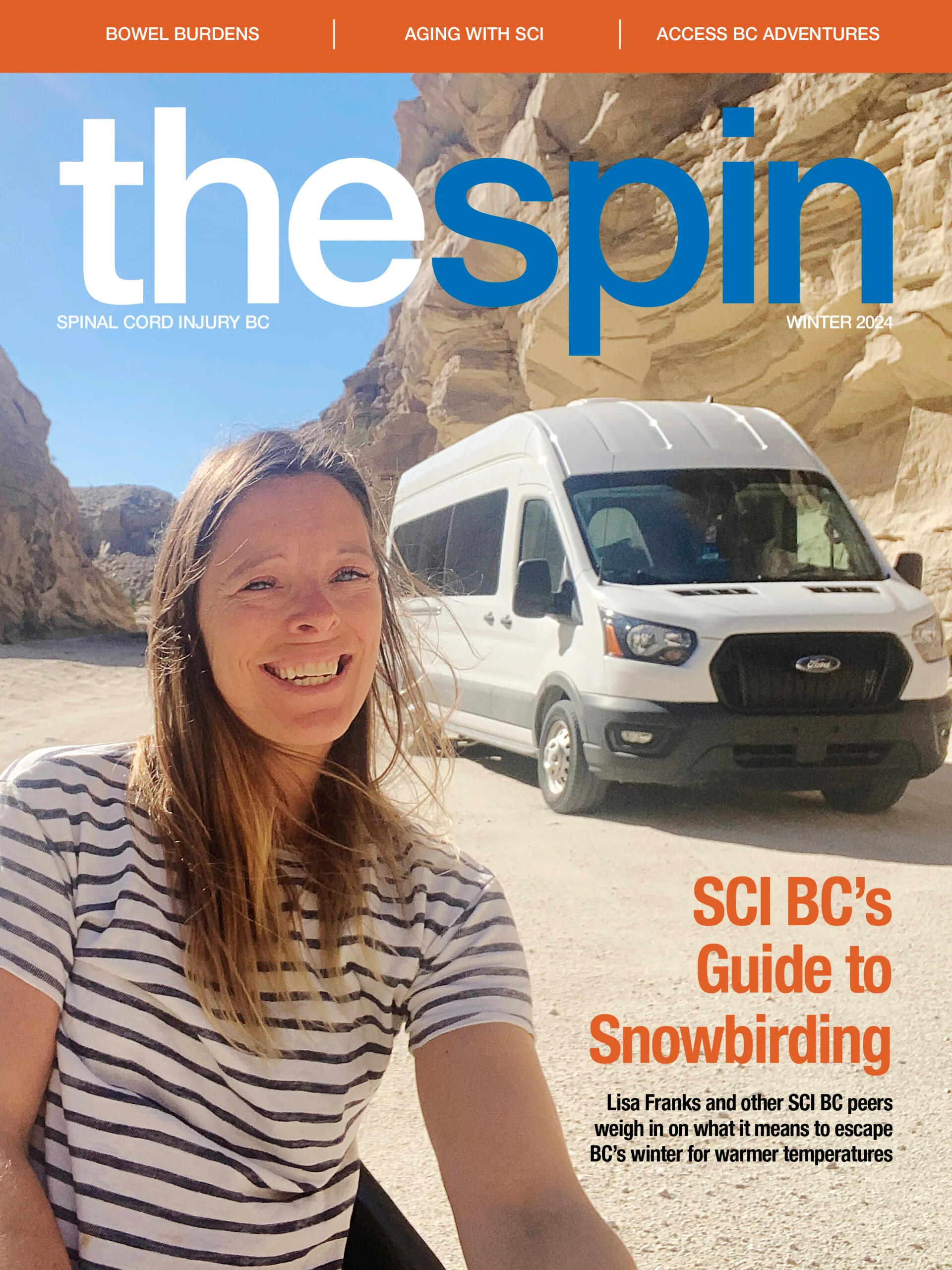
This article originally appeared in the Winter 2024 issue of The Spin. Read more stories from this issue, including:
- Snowbirding
- Bowel research
- Entrepreneurship
And more!


