

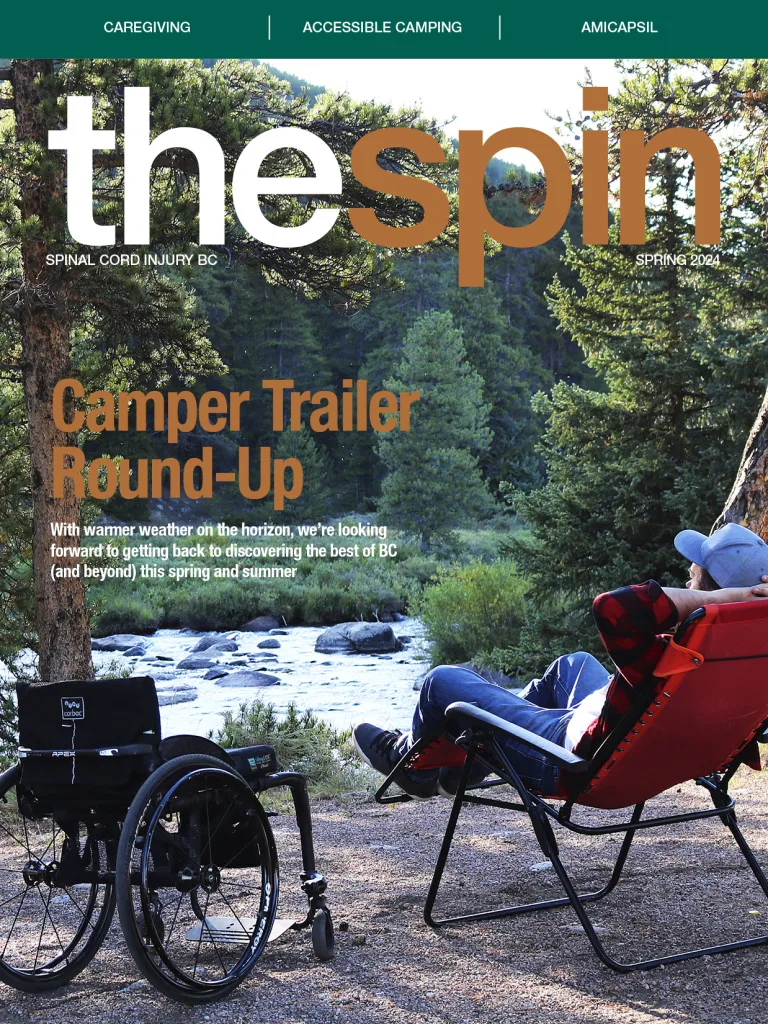
With warmer weather on the horizon, we’re looking forward to getting back to discovering the best of BC (and beyond) this spring and summer. To prepare for the adventures ahead, we talked with SCI BC peers and trailer experts to learn more about the pros and cons of using camper trailers to explore the great outdoors.
nuCamp Camper Trailers

“I really love the outdoors and getting out and it’s always something that I did growing up,” SCI BC peer Kimberly Joines says. “My parents are both teachers, so we always just spent the whole summer camping, you know? So, it’s really just maintaining the same lifestyle that I was used to before [my injury].”
Joines, who is a two-time Paralympic bronze medallist has always been one to embark on new challenges, and camping is no exception. Between 2014 and 2018 Joines and her boyfriend spent an average of 70 nights per year travelling and camping throughout North America. They travelled everywhere from Moab, Utah and Northern California to Inuvik, Northwest Territories, taking in sights and connecting with friends.
To make the trip to the far North possible, they invested in the nuCamp’s t@b Q camper trailer. “If you’re doing a very large trip like we wanted to do, to go up North, that’s six weeks at least and you can’t cover that distance and set up camp every day in a tent. So we knew we wanted a trailer to log a lot of miles and cover more ground,” Joines says. “We also knew we wanted one with a very large bed and this particular model has almost a king size bed, so that sold us. And when the bed is not set up, we can fit as many as six adults around a decent sized table. So, for a very small trailer, it’s super functional.” The trailer also features a 2-burner glass-top stove, sink, cabinetry, a hot water system, central A/C, and a fridge (although Joines notes that these last two features have been temperamental). nuCamp no longer makes this particular model, but a similar option is their 320 S trailer (pictured in this article). The main difference is that the 320 S includes a bathroom, and therefore the bed size is smaller than the t@b Q.
When deciding what type of trailer to purchase, Joines researched different models through the lens of independence. “We looked at the layout of a lot of options when we were shopping, and they definitely ended up in this kind of in between; where you couldn’t really reach anything once you’re in, unless you’re in your chair,” she says. She decided on the t@b Q model because it allowed her to maneuver inside by herself. “I have a leg I can kind of pivot on, so I put my pivot leg inside the trailer and pull myself through the doorway and straight onto the bench seat,” Joines explains, adding that after she transfers, she usually leaves her chair outside if the weather is good or asks her boyfriend to put it in their vehicle. If camping solo, Joines can pull the chair into the doorframe, disassemble it, and store it under the table. “Once you’re inside, you can pretty much reach out to everything in the trailer from the edge on the bench,” she says. “In my early years in a chair, I found tenting worked well because I had a cot and I just wanted to camp, but I do different things now. It’s all about how much work you’re willing to do versus the experience you want to achieve.”
Considering the type of experience you want is the main piece of advice Joines recommends to those interested in purchasing a trailer or starting camping. “We do a lot of mountain biking and that was another one of the main reasons we got the trailer at the time,” she explains. “For most of our camping trips for mountain biking I’d be a shuttle driver, so we needed to be able to transport the bikes but also have a comfortable place to sleep. Having a trailer, rather than an all-in-one camping unit, allows us to detach and leave camp set up while we were off using the truck to adventure. Now we also do motor sports, so we can fit motos in the truck or have space for my amTB [adaptive mountain bike].”
If someone isn’t interested in transporting toys or extra camping gear, or if they don’t need the comfort that comes with a contained trailer then it might not be the best fit. “Before the trailer, our set up was a large tent with a big awning off the front. That was really nice for being able to leave my chair out there and protect all of my gear, so there are options based on your recreation goals and interests.”
Learn more about nuCamp trailers: nucamprv.com/tab-camper.


The 320 S trailer’s bed, sink, and lounge area.
DROPLET Camper Trailer

The DROPLET camper trailer first appeared on SCI BC’s radar when peer, Tanelle Bolt, was featured in an article and video highlighting the wheelchair accessibility of the unit. In 2019, Bolt met the owner of DROPLET trailers, Pascal Pillon, and the two bonded over their love of camping and the outdoors. Eager to hear feedback on the trailer, Pillon lent Bolt a DROPLET trailer for a three-week trip to the Yukon in exchange for her suggestions on how to improve accessibility and a review of her experience.
“We discovered with Tanelle that our campers [are at] chair height so transfer is easy,” Pillon says. “The doors are the widest in the industry, making transfer very easy too and the kitchen is only 15” deep, therefore everything is accessible.” Bolt recommended a few changes based on her experience, including adding a pull to close the trunk of the trailer more easily, and they have been taken into consideration. “We currently offer a free adaptation for wheelchair users based on their abilities,” Pillon explains. “We’re now very mindful of accessibility when we design new features. DROPLET is all about offering opportunities for easy and comfortable camping and [we have] since added accessibility to our design checklist.”
If you’re not ready to commit to purchasing a trailer quite yet, the DROPLET is also available to rent. Ed Bell, an SCI BC peer, opted for this route a few years ago when he rented a DROPLET to travel through Alberta and Saskatchewan and down to Montana, Colorado, Utah, and Arizona before returning home to BC. “We towed the trailer with our 2016 Honda HRV and had no problems towing it other than a decrease in gas mileage, as expected,” Bell says. “Getting in and out of the trailer was not too bad, but if it was mine, I would have some grab bars installed to assist… [at night] we put my chair in a small tent that we would set up as a change room.” Overall, Bell says that the DROPLET was a step up in terms of comfort and contained everything he needed in one small package. “It worked [for me] in my 30s, or 40s when my mobility was better, and I was more active. Now in my 60s, I think what would work for me would be a motorhome with a lift.”
Learn more about the DROPLET trailer: droplet-trailer.com/wheelchair-accessible.

Trailer Advice

SCI BC’s Peer Program Coordinator Ryan Clarkson is no stranger when it comes to hitting the open road. His solo road trips and camping adventures have taken him as far north as Alaska and as far south as the US-Mexican border. Throughout his excursions, Clarkson has experimented with a variety of camp set ups and shares some sage advice.
“Always think about what type of camping you are doing and how are your transferring skills?” This will determine what equipment you need and how you prepare. “If you plan to go to more remote locations down service roads, you will want beefier tires to avoid flats,” Clarkson says. “But larger tires mean higher ground clearance which means a higher surface to transfer to… and some teardrops will have a six-inch gap [or more] between the mattress and door which means you have to transfer on to a hard surface, which means your skin is at risk.”

Over time, Clarkson has developed a keen sense of awareness for these types of considerations and recommends the following when it comes to trailers:
- Learn how to pack your truck and the trailer. A trailer that has been loaded improperly is more likely to cause trailer sway. The weight should be balanced on each side of the trailer, and about 60% of the weight should be toward the front.
- Know what the towing capacity of your vehicle is. Your car might have zero issues towing something around sea level but load it up with camping gear and water and it might not make it over mountain passes.
- Consider your chair. For most teardrop trailers, you are going to have to get comfortable with leaving your chair outside to the open elements or have a partner to pack it away in your vehicle. Some people don’t like the thought of either leaving their chair out in the open for others to see, or having it packed away and not easily accessible in case of an emergency—so think about what you want.
This article was originally published in the Spring 2024 issue of The Spin. Read more stories from this issue, including:
- Peers’ experience of caregiving
- Heart health
- Pressure injury treatment
And more!


