After years of collaboration and planning, one of the world’s greatest natural and cultural wonders is now infinitely more accessible. SCI BC’s Accessibility Specialist Glenys SnowDymond guides us through Naikoon Provincial Park, the important notions of universal design and thematic access, and her own deep-rooted connection to accessibility in Canada’s parks and wilderness.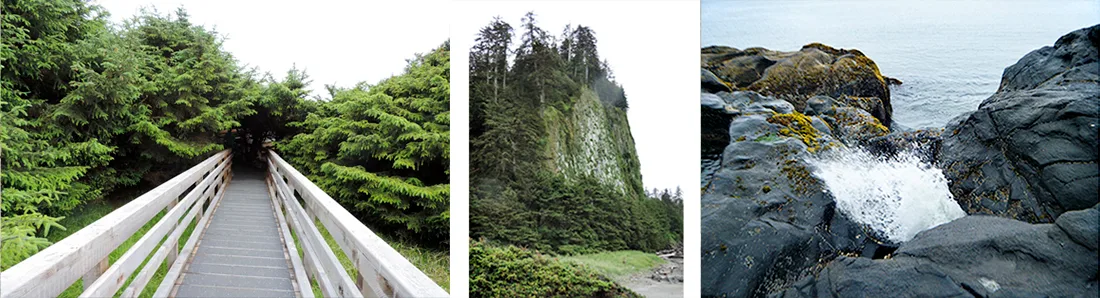
There’s a place on the edge of tomorrow, on the Isles that are called Haida Gwaii. Where the trees reach up towards the heavens, whales blow, eagles soar in the sky.
These lands are sacred to many, first people of culture and clan. Revealed to the world through the hand, voice and brush, of the carver, the painter, and man.

And now, an important part of them has become infinitely more accessible.
Whichever way you visit, it’s a land worth exploring. Located at the northeast tip of Graham Island (the northern of two islands), west of Hecate Strait and due south of Alaska, BC Parks’ Naikoon Provincial Park is a vast expanse of ocean, beaches and old growth rainforest. The Park lies in the traditional territory of OMVC, and is inherently important for social, cultural, health, food gathering, economic, and environmental preservation.
OMVC and the Province of BC have a signed agreement, a Memorandum of Understanding, regarding this and other sacred Conservancy and BC Parks areas on Haida Gwaii. This agreement is committed to “working closely together to maximize opportunities to develop appropriate and accessible facilities with the Parks and Conservancies on Haida Gwaii”—to accommodate all people of varying abilities by acknowledging the right for everyone to access the sacred lands, and experience the environment for culture, education, family activities, recreation, and health and well-being.
This is where I come in. Understanding Nature As a Universal Access/Barrier Free Design consultant, with a history of life and work in Parks Canada, I know the value of our natural wonders and wilderness. I’ve worked in the Canadian Rocky Mountain National Parks as an interpreter and naturalist, and served as an advisor during the National Disabled Access Program. And, well before then, I grew up in and around these very parks, living and breathing and taking strength from the great outdoors.
In the mid-50s I contracted polio as an infant in Jasper National Park, and grew up as a polio survivor living in one of Canada’s most pristine, pure, natural areas. During my times of institutional care and rehabilitation I clung to the images and sense of peace I experienced when I was able to be home with my family in our little town in the Rockies.
Spending hours in the hot pools and nature—carried, driven, lain, in the places that heal the soul as well as the body—provided me with a base understanding that the earth and all of its splendors must be accessible for all people. This fueled my passion to help provide access to Canada’s natural and wild places and landscapes, a commitment implemented in Naikoon Provincial Park, with the Tow Hill Blowhole Boardwalk and Virtual Hike.
In 2010, I was introduced to BC Parks’ and OMVC’s Tow Hill Blowhole Boardwalk project. I was part of a team commissioned to secure support and funds, and to assist with the plans and design of the Boardwalk. The Boardwalk, along with interpretive components, became a focal activity for all of us over the next four years.Creating AccessBC Parks’ and OMVC’s goal was to develop a boardwalk extension to reach beyond the existing 600m boardwalks in the forest at the edge of the land, travelling to the ocean’s edge and bluff, overlooking the Blowhole at the base of Tow Hill. Today, the total trail and boardwalk from the parking area to the Bluff is 1km.
Today, the Welcome Sign at the Boardwalk entrance incorporates two Totems, replicating the legendary characters of Taaw Sdang and his brother. Spinal Cord Injury BC (SCI BC) is noted on the bronze plaque (also cast in braille) as one of the primary organizations endorsing the Tow Hill Blowhole Boardwalk, along with others who supported the project.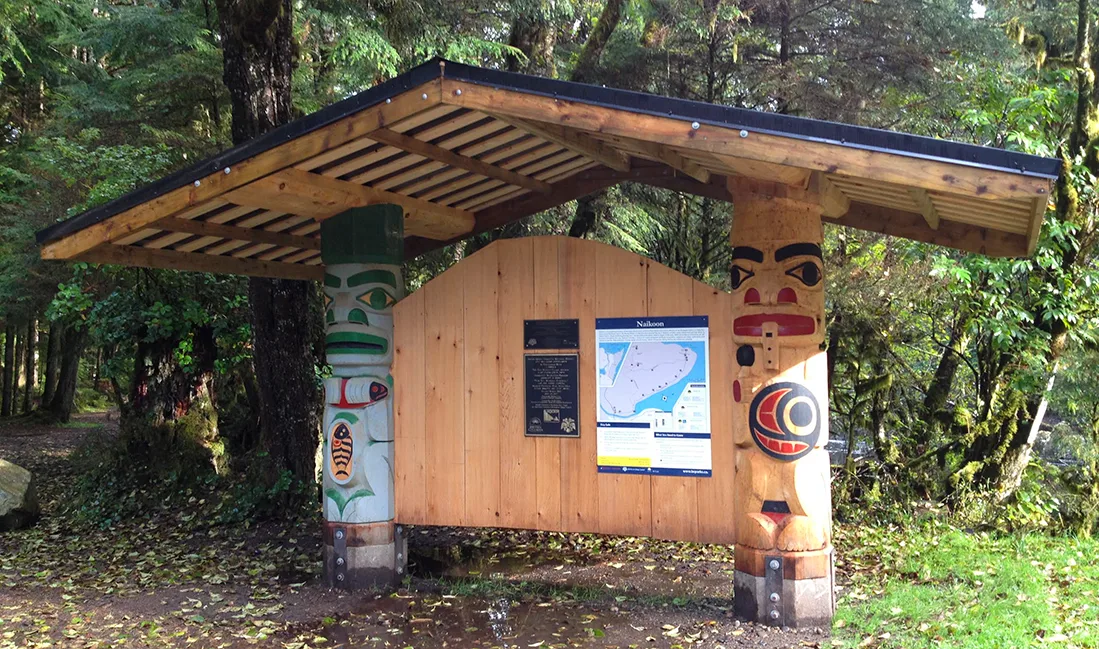


“Thematic access” makes it possible for all people to experience the theme or essence of an area that cannot easily be made available for people with limitations that impede them from going there. Canada’s Human Rights Charter states that all people have the right of access, thus thematic access is provided in places like this, to allow everyone to reach the summit of Tow Hill.
Understanding that this area has great significance to the Haida Nation and is the seat of important myths and legends, it was essential to present the virtual hike in an appropriate manner for the Haida people and the global community.
One section of the Boardwalk goes to the top of Tow Hill while the lower level continues, flowing through the forest—tranquil, interesting, exhilarating—travelling beside the Hiellen River Estuary.

Please check out the Virtual Hike and websites. Live your life for health and adventure. And, whether you visit Naikoon Provincial Park in person or enjoy its many splendors onscreen, always be free to marvel and explore.
The Virtual Hike is accessible at BC Parks’ facebook page and homepage: https://www.facebook.com/YourBCParks | bcparks.ca
For local accommodations at the Hiellen Longhouse Village, contact Ph: (250) 626-3337 | Tf: 1-888-378-4422


