
Rehab Rap: Botox for SCI Complications

Dr. Andrei Krassioukov explains how Botox can reduce SCI complications with input from SCI peers Teri Thorson and John Chernesky.
Why Number Two Is Priority One

SFU Researcher Dr. Victoria Claydon recently completed an ambitious three-year study on bowel care, and its relationship to autonomic dysreflexia and quality of life. The results are eye-opening.
Take a Pass On the Snake Oil but Not These SCI Exercise Guidelines

We live in a golden age of quackery in which we are constantly bombarded by fake news and bogus “science.” So how do we know which guidelines to trust?
A Holistic Approach to SCI: Bridging the Gap Between Mental and Physical Health

Research shows that mental and physical health are deeply intertwined. So why do we keep separating the two?
Want to get me riled up?

There’s a new false hope being marketed to you.
On the brink of a cure?
Don’t be fooled by flashy headlines about SCI cures. SCI BC’s Executive Director, Chris McBride shares his thoughts on the latest “cure”.
Snotty spine: a good investment?
In the latest The Spin editorial, Chris McBride discusses balancing SCI research for better outcomes.
New research restores voluntary movement after complete SCI
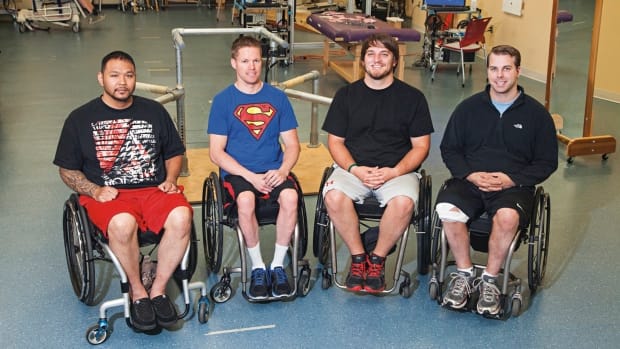
“If it was just about the walking, spinal cord injury would be easy.” This statement by an SCI BC Peer Coordinator is consistent with what the majority of people with SCI have been telling researchers for years – that walking is not the most important return of function to them.
Does a surge in StemCells Inc stock price mean a cure for SCI is closer?
On February 12, StemCells Inc released their twelve-month results from the first patient cohort in the company’s Phase I/II clinical trial of its proprietary HuCNS-SC® product candidate (purified human neural stem cells) for chronic spinal cord injury. Investors liked what they heard, sending StemCells Inc’s stock price soaring. Could this mean a cure for SCI is around the corner?
Of noses, dogs and cure for spinal cord injury

“This is not a cure for spinal cord injury in humans — that could still be a long way off. But this is the most encouraging advance for some years and is a significant step on the road toward it.”
Hype and hope: the realities of SCI research and the cure
Research. It is a slow and tricky business. It creates a lot of hope. But, it also creates a lot of hype that too often exceeds realistic hope.