
In 2017, the Government of Canada reported that just 59% of individuals with disabilities aged 25 to 64 were employed. By 2022, spurred forward in part by the enactment of the Accessible Canada Act, employment rates rose to 62%. This increase indicates progress towards the Accessible Canada Act’s goal of a barrier-free Canada by 2040, but it doesn’t represent the full picture.
Occupational health and safety (OHS) research by Curtis Breslin, a professor at Toronto’s Seneca College, revealed that workers with disabilities are more likely to experience OHS vulnerability. Specifically, Breslin found that “a disability at work was significantly associated with greater hazard exposure.” The study, published in Disability and Rehabilitation and supported by Toronto’s Institute for Work and Health, also noted that people with disabilities were more likely to be employed in conditions where hazard exposure was combined with inadequate policies and procedures or inadequate empowerment. In this way, people with disabilities experience both a lower rate of employment (compared to the 78% national average for people without disabilities), and if employed, a higher likelihood of unsafe working conditions and feelings of disempowerment.
“We know from research that people with disabilities are perhaps more reluctant to speak up and ask for what they need, and that they face more safety challenges,” says Helen Chandler, an Industry Specialist from WorkSafeBC.
For over 100 years, WorkSafeBC has played a pivotal role in supporting workers and establishing a no-fault insurance system that provides fair compensation. Chandler, whose role encompasses developing and implementing programs that improve workplace health and safety, has recently expanded her focus to include building relationships with the BC disability community to address inequality issues highlighted in employment research. “We’re trying to make connections with different groups [and] make sure that people with any kind of challenges know what they can ask for, what they should be asking for, and what their employer should be providing for them,” she says.
In October 2024, Chandler presented at the annual BC SCI Network meeting to staff representing all five of the Network organizations (Spinal Cord Injury BC, Neil Squire Society, Disability Foundation, BC Wheelchair Basketball, and BC Wheelchair Sports). Her presentation focused on the rights of workers and the resources available to support them. “In BC, all workers have three basic rights,” Chandler explains. “They have the right to know what hazards are and how to control the risks. This could be very specific for somebody who, for example, is in a wheelchair. Let’s say they’re working near a conveyor belt or a dip in the ground; those are areas where their wheels might get caught, and the employer needs to think about these things and respond to them. They should be asking, what are the particular hazards for that particular person and how can we mitigate them? Workers also have the right to refuse unsafe work and the right to participate—which means the right to speak up or ask questions.”

However, as Breslin’s research indicates, invoking these rights is easier said than done. Out of nearly 2,000 research participants, those who self-identified as having a disability were almost twice as likely as those without a disability to report workplace vulnerability due to exposure to hazards and a lack of empowerment. It’s an unfortunate chicken-and-egg dilemma that employees with disabilities can’t avoid. Does having a disability lead to feelings of disempowerment and vulnerability, which increase hazard exposure? Or does the increased exposure to hazards in relation to having a disability result in disempowerment?
“It’s definitely a balance,” Chandler acknowledges. “I once had someone in a wheelchair tell me that she got a job when she was younger and didn’t want to speak up because she didn’t feel like she ‘earned’ it in some ways and knew she already stood out from [her co-workers]. She felt grateful to even have a job and didn’t want to make waves… our education sessions are all about trying to make sure people know their rights so they can act confidently.”
The Neil Squire Society is familiar with the complicated dilemma facing people with disabilities seeking employment or presently employed. Their programs, such as Creative Employment Options, Solutions, Computer Comfort, and Distance Computer Comfort aim to empower people with disabilities and build the skills needed to secure and excel in employment. Their newest program, Empower3D, launched in February 2025, provides youth with disabilities with the opportunity to develop transferable skills and gain valuable work experience in the manufacturing sector. Over the next two years, 10 groups of participants will participate in a 14-week skills-based training program and a 12-week full-time paid work experience.

“The curriculum covers soft skills. We talk about communication, teamwork, and we also teach them professional practice. On the technical side, the program teaches specific skills that are needed in manufacturing roles,” explains Empower3D Workplace experience. Kristina Mok, Program Manager at Neil Squire. Additionally, the Empower3D program will feature a guest presentation from Chandler about workers’ rights, with a focus on increasing confidence in new employees. “I love to see young, new workers with disabilities on a joint health and safety committee,” Chandler says. “That really gives them a voice and a chance to speak up about their particular safety needs,” adding, “one of the things we usually suggest to anybody who’s a little hesitant to speak up is to talk with your co-workers. They may have experienced the same thing, and if you can approach your supervisor with the support of other people, that’s always helpful. A good employer will want you to bring things forward. They’ll want to help—it’s a win-win for them.”
To be eligible for Empower3D, participants must have a self-declared disability and be between the ages of 15 and 30. Work environments are dependent on the hiring needs of employers during the cohorts’ placement. Therefore, due to the dynamic nature of these environments and the specific requirements of manufacturing facilities, wheelchair accessibility cannot be fully guaranteed at this time. However, Neil Squire hopes this won’t discourage interested participants from contacting them and expressing their interest. “This is a big priority for us right now. We have meetings coming up with our partners and employers, and it’s helpful to know the level of interest from participants who would need wheelchair accessible placements. If that’s something you need, we will find a way to make it happen,” Mok says.
Like Neil Squire, WorkSafeBC encourages people to get in touch with their questions or concerns. “I would love to hear from [SCI BC] members about their experiences on the job. I’d love to hear stories about something they helped fix at work, or maybe something that never got fixed,” says Chandler. “Rights are the same for everybody in BC, but maybe there needs to be some resources specific to people with disabilities, and we want to help create those. It’s corny to say, but safety is good business.”
Review your workers’ rights and find resources at worksafebc.com/for-workers. Connect with Helen Chandler at helen.chandler@worksafebc.com.
Learn more about Neil Squire’s Empower3D program at neilsquire.ca/empower3d or email the team at empower3d@neilsquire.ca.
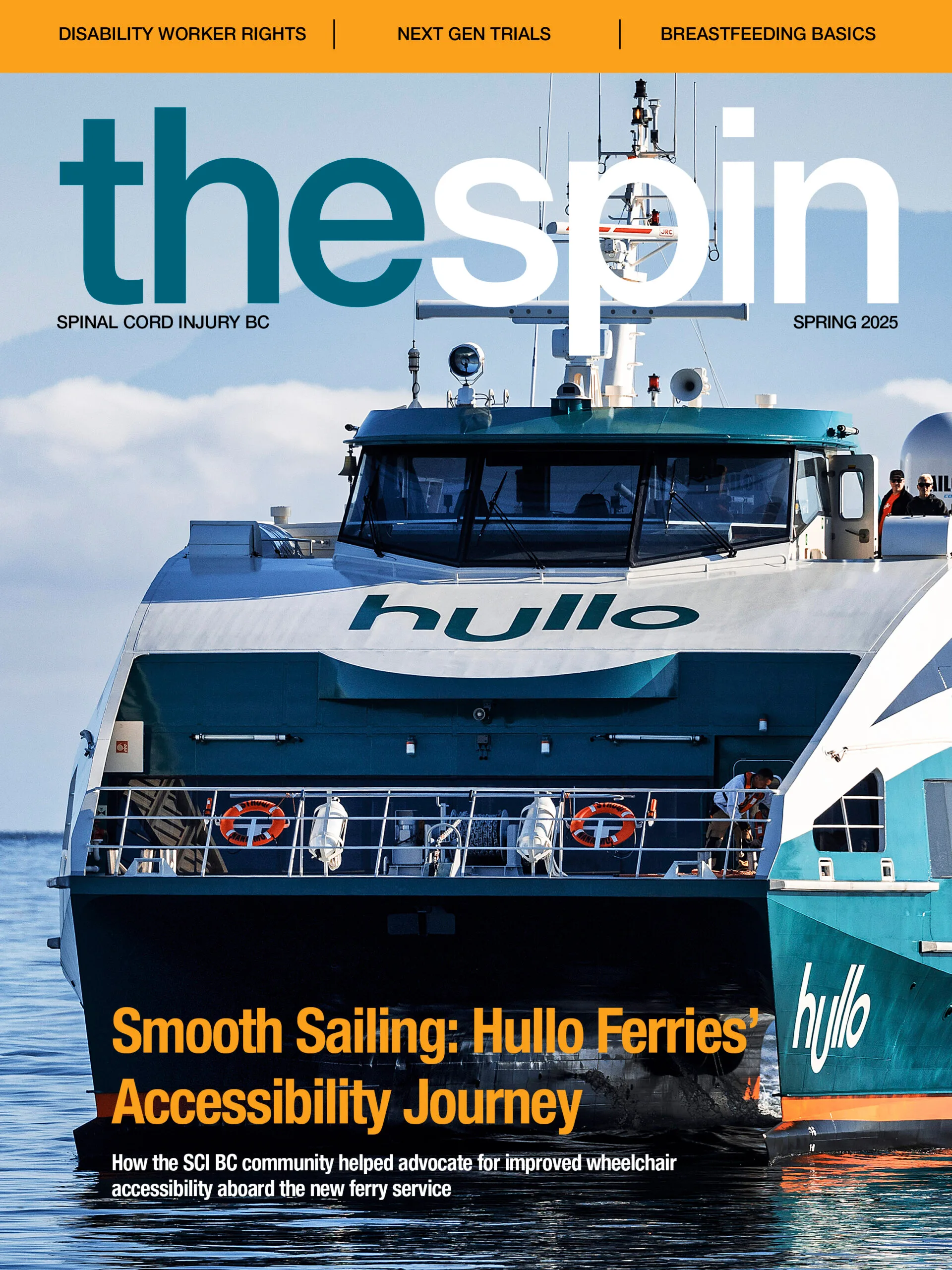
This article was originally published in the Spring 2025 issue of The Spin. Read more stories from this issue, including:
- Ferry accessibility
- Breastfeeding
- Next gen clinical trials
And more!


