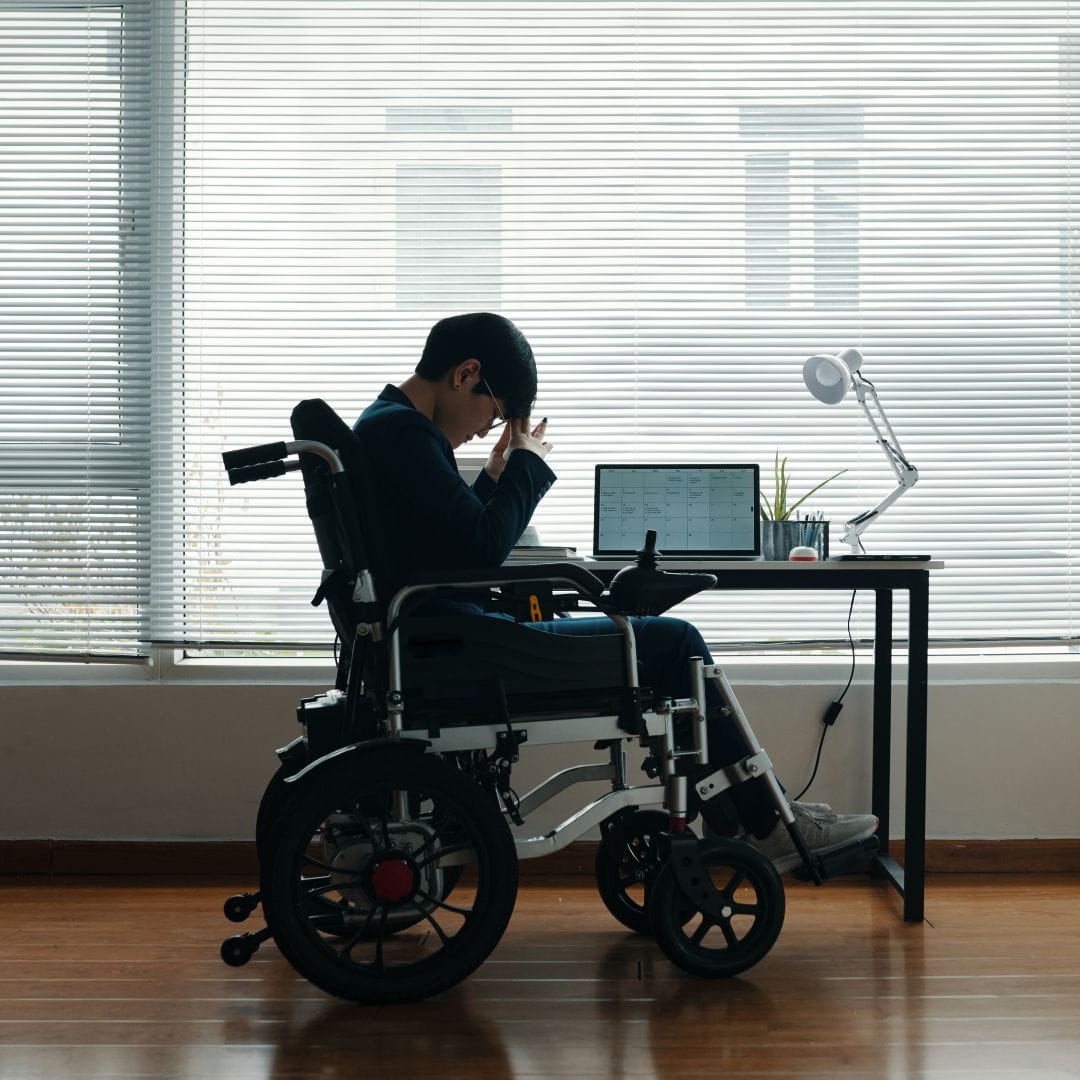

For wheelchair users, shoulders become the workhorses of mobility. It’s a job they weren’t exactly designed to do, as many peers have found out later in life when their well-used—and often overused—shoulders sustain painful, mobility-compromising injuries that require surgery.
The good news is that rotator cuff repair surgery is readily available in our health care system. Not only that, surgical techniques have greatly evolved over the past couple of decades— injuries once thought to be inoperable because of their severity are now routinely repaired with good rates of success.
There are, of course, many different types of injuries and many creative ways of repairing them—far too many to describe here. But they all have one thing in common: recovery is a long, painful process that requires approximately one year from start to finish. It starts with patients being virtually helpless from a mobility perspective. For the first six weeks, their arm must be completely immobilized in a sling with an abduction pillow. Gentle range of motion exercises are typically introduced after that, and gentle strengthening exercises follow. But patients remain restricted from doing any weight bearing activities for at least 10 weeks, and often as long as six months. That means zero transfers; zero pushing or wheeling. In essence, patients are one-handed for months.
After that, gruelling rehab sessions become the order of the day. Not only do patients have to build strength and range of motion in their reconstructed shoulder, they have to rebuild muscles that have greatly atrophied because of lack of use in the initial post-surgery rest period.
The bottom line is that surgery is the easy part of the process. However, beyond the pain and compromised ability of recovery lies gratification—patients typically report high levels of satisfaction as they regain the ability to use their shoulders without the debilitating pain that they often lived with for years prior to their decision to have surgery.
We know that many peers are considering this surgery, or are already on the list to have shoulder reconstruction. And so for this issue of PeerSay, we reached out to two peers who have had their shoulders recently reconstructed, and asked them about their experiences preparing for and enduring the lengthy recovery and rehab process. It’s unlikely that their specific surgeries will be exactly like yours, but it’s our hope that their accounts will give you some idea of what to prepare for. Our thanks to Debbie Richardson and Marnie Abbott for graciously sharing their stories.
Debbie Richardson

Debbie Richardson is well known to many peers—she’s active in our Lower Mainland community, and is the creator of the B.C. Paraplegic & Quadriplegics group on Facebook. Now 67, Richardson is an incomplete paraplegic who was injured in 1981.
She’s had two shoulder surgeries. The first, which took place in 2008, was relatively straightforward and only took about eight weeks to heal completely. She spent the entire eight weeks in hospital, where she had all the assistance she needed during the time she was immobilized. The surgery was a success, and when she was discharged, she was able to quickly get back to her life.
But in 2018, she severely injured the same shoulder while transferring between toilet and chair.
“I could feel my left bicep and back of shoulder tear, and great pain like sharp knife tears—worst pain ever!” she says. After two years of trying various therapies, she was examined by orthopaedic surgeon Dr. Farhad Moola, who booked her for shoulder reconstruction. That was in 2020.
This time, she didn’t get off so lucky.
“The surgeon didn’t know until the operation what he would find and have to repair,” says Richardson. “It ended up being a far more complex surgery with many things needing to be repaired. He wanted me to stay in bed for five months. I didn’t expect that—I thought it would be eight weeks like the first operation on my shoulder.”
This time she wanted to recover at home, which her surgeon agreed to. She had prepared extensively for her recovery.
“I had two baskets on one side of my bed with extra pee bottles, leg bags, catheters, baby wipes, Kleenex, paper towel, blue pads, reading book, tablet, TV remote, tic tacs, cough candies, bag of chips, dry hair shampoo, pen, notepads, calendar, comb, brush, hand cream, bottle water, anything I use daily—was in my baskets so I didn’t have to bother hubby for things all the time.”
Despite her prep, Richardson says the recovery was gruelling, mainly because she had to stay in bed for five long months. But she says the situation was made worse because the home support she was counting in from Fraser Health home care was substandard compared to her previous experiences. Workers failed to show up at scheduled times, or had little time when they did arrive. They didn’t know how to assist with her bowel program or change her leg bag. And there was the ever-present threat of COVID-19.
“My husband was so upset with workers not listening to the care I needed that we cancelled after several weeks,” she says. “My husband, who shouldn’t have to, became my primary caregiver and even checked my bowels—not a great job for hubby.”
Not surprisingly, Richardson recommends that, if you have the surgery and intend to recover at home, you need to check and double check that your home care supports are going to be adequate and in place.
“Make sure through your health unit that they know exactly what you need—particularly with bowel and bladder care,” she says. “I set this all up before the operation, but the system failed me this time. Document everything that’s been agreed to.”
She concedes that some of the home care issues were likely due to the pandemic, and that her experiences with physio and occupational therapists were excellent.
“I had physio after eight weeks at home,” she says. “Then I believe on the fourth month I started with occupational therapy, and started building the strength to start transfers, brushing teeth, washing up. I had to get stronger before starting to transfer to toilet and bathing. You will know when you feel safe to do those things. You will be weak, so have patience with yourself. The occupational therapist got us a portable lift so that my hubby could get me up three times a day, breakfast, lunch and dinner until I could stay up longer period of times.”
Was it worth it? “Over all,” she says, “yes, well worth it. Before you know it, you’ll be back up and doing things again. My shoulder is good as new with no pain. I just have to be careful, which is hard sometimes; if you fall you automatically try to save yourself, thus tears happen then. If I ever think I have torn my shoulder again, because I am older, I would try to work with the pain if I could. But I would do another operation if it was painful like it was the last time, as you can’t do much without it repaired.”
Marni Abbott-Peter

Marni Abbott-Peter is another well-known peer on the Lower Mainland. She’s enjoyed an incredible career in wheelchair basketball, winning three Paralympic gold medals and four World Championship titles. She’s lived with T4 paraplegia for 39 years.
Steadily worsening chronic pain in her left shoulder led her to seek medical advice.
“I actually think sports helped keep my shoulders healthy; it was when I retired from sport that I started experiencing problems,” says Abbott-Peter, who is now 56. “MRI determined my shoulder joint had completely deteriorated due to osteoarthritis. The surgeon wanted to do the operation immediately, but I was afraid of the rehab and waited almost five years before finally agreeing to do it. I managed the pain with cortisone and Tylenol but it was getting increasingly worse, limiting my activity and making daily living a challenge.”
Her surgeon, St. Paul Hospital’s Dr. Jeff Pike, booked her in for surgery in September 2020. She knew exactly what her post-surgery would entail. But her recovery plan was exactly opposite of Richardson’s.
“I was adamant that I could not go home for rehab and had to advocate very, very hard, along with my GP and my surgeon, to get me into a facility post surgery,” she says. “GF Strong would not take me as I was not acute, and there are very few options for people with SCI for post-surgical care or any other medical issues; they expected me to go home and there was no possible way that would work for me or for anyone else with an SCI. That was the biggest cause of stress throughout the whole thing—even going in on the day of the surgery, nothing had been decided, but my surgeon assured me they would keep me at St Paul’s if need be.”
Fortunately, she was admitted into Holy Family Hospital, a rehab facility for seniors.
“They had very little experience with SCI but were fully equipped for it,” says Abbott- Peter. “I got excellent care there, I would not have managed without being there.”
She says the first few days were an ordeal.
“I thought I was well prepared, but truly, it was like a hard punch in the gut,” she says. “In the first few days after the surgery, as I was trying to manage with one limb, I was really regretting my decision. But my husband and my surgeon helped me through it, and once I got to Holy Family Hospital, I felt much more confident in everything.”
That’s not to suggest that the ensuing recovery and rehab weren’t gruelling.
“It was a lot harder mentally than physically for me,” she says. “With my background as an athlete, I was raring to go and had to really work hard to be patient and not do too much too soon. All of this was in the thick of COVID as well, but the docs, nurses and staff at Holy Family were amazing and so positive, it made it manageable. There wasn’t much pain at all, the toughest part was the first week, once I was able to get up into a power chair and move around freely things were much better. I had to use a lift for all transfers and a power chair for three months. I was cleared to start using my day chair on after four months—that was a big transition and took some time to adjust to doing transfers with a sliding board. Once I mastered that, I was able to go home and continue my rehab there.”
Her surgery was a complete success. “It was 100% worth it,” she says. “I did not realize the impact that daily chronic pain was having on my overall well-being. Surgery was tough, I admit, but certainly well worth it. I have one small scar across my pectoral and the front of my shoulder that is barely visible. My shoulder is strong and has full range of motion—it has no pain whatsoever and I am fully confident in using it. I am still gaining back my power and strength overall but there were a few factors unrelated to the surgery that impacted that, including getting a serious bout of the delta variant of COVID in 2021—which I still have some lingering effects from.”
The single-most important piece of advice she has for peers considering shoulder surgery is fight for the right to do your first few months of recovery in a rehab setting.
“There is no possible way to do it successfully at home with home care or with a spouse or partner. That is completely unrealistic, and the surgery will be a waste of time. In fact, I believe that many surgeons will not even consider this type of surgery if you’re a person with an SCI, mainly because of the poor rehab options available to them. This says a lot about some of the glaring holes in our medical system in BC and Canada.”

This article was originally published in the Summer 2022 issue of The Spin. Read more stories from this issue, including:
- Catheter Coverage Research,
- Adaptive Bikes
- SCI and Sexual Health
And more!