
Dealing with a new spinal cord injury can be overwhelming. The resources below will assist you and your loved ones through this uncertain time.
You can contact the SCI BC InfoLine at info@sci-bc.ca or 1-800-689-2477 to help you get started. We also recommend you get in touch with your local Peer Coordinator for additional support and advice from someone who knows what you’re going through. They will be able to tell you more about our Peer Program and how we can help.
No one prepares for a spinal cord injury, and nobody should go through it alone.
Since 1957, SCI BC has been reaching out to help people with spinal cord injuries, their families and friends to adjust, adapt and thrive after SCI. The journey isn’t always easy, but we’re with you all the way.
Our roadmap brochure is a guide to how SCI BC can support you throughout your journey – click to download the PDF version – or contact our InfoLine to receive this brochure by mail.
If you’re at the GF Strong Rehab Centre ask one our Peer Program Coordinators for a Peer Family Kit. This kit is a helpful guide for families temporarily living in the Lower Mainland area and contains useful information about the local area including accessible accommodation and maps, and information related to life after a spinal cord injury. If you live outside of the Lower Mainland, please email info@sci-bc.ca and ask to have a kit mailed to you.
Visit LivingWithSCI.ca for everything you need to know about SCI from the people who’ve been there. Created in partnership with the GF Strong Rehab Centre.
Where will I (or my loved one) live?
Almost all people with SCI live in the community, and funding support and attendant care can help you to live independently. You may need to adapt your place or look for an accessible home. Some wheelchair accessible homes are available, many of which are subsidized for those who are low income.
Will I (or my loved one) be able to go back to work?
Many people with SCI work! Some return to their previous job and some train for something new. Employers have a “duty to accommodate:” to modify the workplace or policies for workers. Organizations like the Neil Squire Society can help you get back to work after SCI – contact them or ask your social worker. Check out our many resources on our Accessible Employment BC resource. Look for help on our Work After SCI page on LivingwithSCI.ca and keep your eyes open for vocational rehabilitation counsellors at GF Strong Rehab Centre.
Will I (or my loved one) still be able to have sex?
YES! SCI doesn’t mean you can’t have sex, but there may be some challenges. Fortunately, in BC we have an excellent Sexual Health Rehabilitation Service to help you get your mojo back after SCI, ask your clinician for a referral or visit our SCISexualHealth.ca site for more information on your sexual health after Spinal Cord Injury.
Will I (or my loved one) ever walk again? Why are doctors so vague about the prognosis?
Every SCI is different – there are many factors that affect whether someone will walk again. The potential to regain function depends on the level and completeness of injury and it is very difficult to know how much of the spinal cord has been spared. Everybody’s recovery is different! Focus on maximizing your potential during rehab and back in the community, and try not to compare your progress to others.
Read more on Understanding SCI including information on what your injury level means and why you need to know about it.
What is it like to live after spinal cord injury? Nobody knows this like someone who’s been there!
Talk to an SCI BC Peer Coordinator to get involved in our Peer Program. Ryan and Teri both live with a spinal cord injury and work at SCI BC’s Resource Centre at GF Strong. Our Peer Program is all about fun and connection. Join us for events and activities that give you a chance to learn how others do things, try something new and talk to people who know what it’s like to have an SCI.
Find a Peer Coordinator near you and learn more.
Our SCI Info Database contains hundreds of resources relevant for people with an SCI. Search the Database for information on topic areas such as advocacy, building and universal design, education, employment, funding, health, recreation and leisure, accessible transportation, travel and more.
BC Wheelchair Basketball Society: Provides people with SCI in BC the opportunity to participate in wheelchair basketball programs.
BC Wheelchair Sports Association: Provides opportunities for athletes with physical disabilities, and promotes wheelchair sports throughout British Columbia.
Disability Foundation: Promotes the capacity and talents of people with disabilities through various programs, and encourages outdoor participation.
Neil Squire Society: Uses technology, knowledge and passion to empower Canadians with physical disabilities.
ICORD: an interdisciplinary research centre focused on the development and translation of more effective strategies to promote prevention, functional recovery, and improved quality of life after SCI.
Note: The first four sections below are taken from the Canadian Paraplegic Association publication, Life after a Spinal Cord Injury. If you would like a copy of this publication please contact the SCI BC InfoLine.
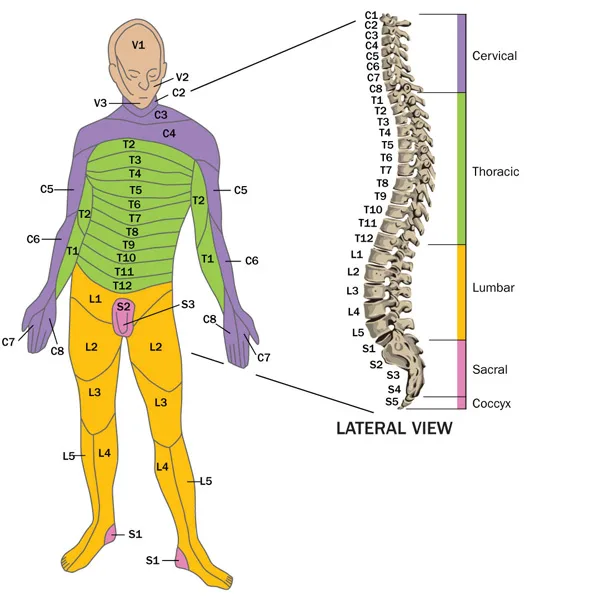
Your spine consists of 33 vertebrae:
- 7 cervical vertebrae – neck (C1 to C7)
- 12 thoracic vertebrae (T1 to T12)
- 5 lumbar vertebrae – lower back (L1 to L5)
- 5 sacral vertebrae (S1 to S5)
- 4 fused vertebrae that form the coccyx
The vertebrae are attached and held together by ligaments on both sides of the spine. The Vertebrae are separated from each other by a disk made of cartilaginous material. When we move, these disks absorb and reduce the pressure between the vertebrae.
The spine may be compared to a flexible tube. The holes in the centre of each vertebrae form the spinal canal. Through the interior passes a ‘cord’ of nervous tissue called the ‘spinal cord’. The spine’s principal function is to protect the spinal cord.
The spinal cord which is made of nerve cells and nerve fibres, resembles a cable about the size of your little finger.
Approximately 21 inches (52.5cm) in length, it begins at the base of your brain and passes through the interior of each of your cervical and thoracic vertebrae. It ends at the upper level of your lumbar vertebrae (the superior border of L2), where it branches into a collection on nerves that extend down to the region of the coccyx.
Simply put, the spinal cord works like a two-way telephone line. Via this communication pathway, the brain sends and receives messages to and from different parts of your body. This is how it can ensure the proper functioning of the vital organs as well as muscle movement. Commands from your brain and sensations from your body are translated into a nervous impulse comparable to an electric current. The impulse travels the length of the spinal cord and the nerves.
A spinal cord injury (SCI) damages the communication pathway between the brain and certain parts of the body. Depending on the extent of the damage and its location in the cord, serious and permanent physical consequences will result in varying degrees of severity. Limbs or organs will not function as they did before.
Injury to the spinal cord, also known as a spinal lesion, can affect certain physiological functions. The ability to move muscles, as well as the sensation of touch may be affected. Blood circulation, the elimination of urine and intestinal wastes, and respiratory capacity may be altered. These are just a few examples of how the body might change after a Spinal Cord Injury.
The level of paralysis is determined by where the damage occurs in the neck or back.
Paraplegia: is the result of a spinal cord lesion located at the level of the thoracic vertebrae or lower down in the lumbar/or sacro-coccygeal regions. Loss of motor function or sensation affects the legs and the lower trunk.
Quadriplegia (or Tetraplegia), is the result of a spinal cord lesion at the level of the neck (cervical vertebrae). A loss of motor function and sensation or of both together, occurs in the legs, arms and trunk, including the thorax (chest). The severity of the loss does vary.
We have a selection of cushions available to use if you require a pressure relief cushion but can’t use your own. Some very rigid wheelchair cushions like the RIDE Custom cushion are not suitable for use on a handcycle.
For Group Rides, if you’re riding your own bike please make sure to bring your own helmet (or email us if you need to borrow one), and ensure your own bike is in good repair and safe to use (functional brakes, steering, gear shifting and tires).
All participants must wear a functional helmet that fits your head and must:
- have a smooth surface
- be built so it’s capable of absorbing energy on impact
- be strongly attached to a strap designed to be fastened under your chin
- be undamaged and less than 6 years old.
Participants riding our bikes will be supplied a helmet, those riding their own adaptive bikes should bring their own helmet meeting the criteria above or let us know they need to borrow one.
- Traumatic injury resulting from physical trauma to the spinal cord, caused by motor vehicle crashes, falls, sports injuries, or other incidents.
- Acquired diseases that can cause tumors or cysts on the spine, or viral or bacterial infections (including polio). Other diseases such as multiple sclerosis can, in some cases, deteriorate to the point of causing lesions on the spinal cord that can result in paralysis.
- Congenital disorders, such as spina bifida, where the spinal cord is malformed or exposed at birth.
Currently there is no cure for spinal cord injury. Although researchers continue to make steady progress toward understanding spinal cord injury and new strategies to overcome it, a cure is likely to be a long way off in the future.
In the meantime, researchers have made a number of advancements that allow individuals with a spinal cord injury to maximize their potential through neuroprotection, rehabilitation, assistive devices, and many other aspects of emotional and physical recovery.
SCI BC is a strong supporter of spinal cord injury research and is a proud partner with ICORD, UBC and Vancouver Coastal Health Research Institute’s world-leading spinal cord injury research centre located within the Blusson Spinal Cord Centre on the Vancouver General Hospital campus. SCI BC also works with the Praxis Institute and other researchers and research organisations across Canada and around the world.
(Source: Praxis Insititute)
- Over 12,000 people in British Columbia with spinal cord injuries that affect every aspect of their lives.
- Approximately 500 new SCI cases every year in British Columbia.
- The estimated lifetime cost of living with an SCI in BC is $1.6 – 3 million.
- The annual increase in the economic burden of SCI in British Columbia is $1.1 billion.
- The leading cause of injury is motor vehicle accidents (35%), followed by falls (17%).
(Source: Praxis Institute)
- Estimated 85,556 people with spinal cord injury in Canada.
- Approx 44,000 sustained an SCI as a result of traumatic injury (motor vehicle crashes, falls etc).
- Estimated 4,529 new cases of spinal cord injury in Canada each year, 1,786 as the result of traumatic injury and the rest as a consequence of diseases and other non-traumatic causes.
- Almost half of new traumatic injuries occur in people 15 to 39 (mainly male) as a result of motor vehicle accidents, sporting accidents and other external causes.
- The incidence and prevalence of non-traumatic SCI is on the rise. Approximately 50 per cent of new cases of SCI result from non-traumatic injuries caused by infection or disease (including cancer) rather than traumatic causes.
- Cases of SCI are projected to increase over the next two decades, with the number of new traumatic and non-traumatic cases increasing from the 4,700 estimated for 2010 to 6,400 new cases estimated in 2030; and from the current estimated 86,000 persons living with SCI in 2010 to 121,000 persons in 2030.
- Canada’s ageing population is having an impact on the mean age of people who suffer a SCI and the type of care and services required. In the coming decades people who suffer a spinal cord injury are likely to also be older and the causes of these injuries will shift e.g. older people falling rather than young males in motor vehicle collisions.
- The current annual economic burden of traumatic SCI in Canada is approximately $3.6 billion, of which $1.8 billion is associated with direct health care costs.