The popularity of adaptive climbing, or paraclimbing, continues to grow. Organizations and groups are springing up in different locations around the world. Recently, the International Federation of Sport Climbing (IFSC) has stated its intention to promote paraclimbing as a Paralympic sport.

Identifying the need to develop protective climbing gear for adaptive climbers
The Canadian Adaptive Climbing Society (CACS) aims to make climbing accessible to everyone. To date, it has chapters in Vancouver and Toronto, with more planned. But as CACS quickly discovered, the sport had a lingering problem: how do you protect the lower limbs and skin of climbers with SCI, who are often not only unable to prevent scrapes and bruises, but also can’t feel when they’re actually happening?
CACS Co-Executive Director Brent Goodman wracked his brain trying to come up with a solution. That’s when he thought of chainsaw chaps. They were ugly, orange and grease stained—but they offered full leg protection, were easy for chair climbers to put on and take off, and could be used with knee pads.
While effective, the chaps were far from perfect. Enter SCI BC peer and avid climber Kevin Priebe (you may recall we featured Priebe and his new custom mobility manufacturing business, Society Wheelchairs, in our Winter 2019 issue of The Spin).
Refining climbing chap prototype
Priebe volunteered to work with Goodman on a number of practical improvements. They changed the fasteners so the chaps could tighten around the leg and hip more securely, added grab loops around the knee for quick repositioning, and a stirrup around the ankle to keep the climbing harness from pulling them up. Then he worked with CACS to transfer all of these design features onto material that was durable and added climbing rubber to the knee.
It was a big improvement, and since they were easily put on, they could be used by different climbers. Perhaps the only drawback was that they didn’t really offer a personalized (and stylish) solution for more serious climbers.
Last August, in a stroke of serendipity, a student at Kwantlen Polytechnic University’s School of Design, made contact with CACS. Hanae Yaskawa was searching for a meaningful capstone project to help her graduate from the school’s Technical Apparel Program. She had actually thought of an adaptive climbing pant even before she learned about the work CACS and Priebe had already done with the chaps.


New partnerships take the initial concept to a stylish solution
Goodman agreed that Yaskawa’s idea was a perfect fit. An agreement was reached, and work began with Yaskawa visiting Priebe to see the progress to date with the chaps, and researching other solutions developed by climbers around the world. She then worked with Priebe to develop a prototype.
Meanwhile, another willing collaborator signed on with an offer of design and financial support—Arc’teryx, the BC-based high performance outdoor clothing and equipment company known for leading innovations in climbing, skiing and alpine technologies.
Late last year, the collaboration’s efforts came to fruition with a finished prototype, which was appropriately dubbed Resilience. Since then, it has passed testing with flying colours. The goal now is to continue to refine the prototype and ultimately, make it available to climbers on a bespoke basis.
Meanwhile, the chaps and the Resilience pants offer two new great protective options for climbers with disabilities.

Two distinct adaptive climbing products
“The main difference between the Resilience pants and the chaps is that the pants are designed for an individual person,” says Goodman. “The chaps are intended to be a little more universal, where they can be used by one person while they climb, and then quickly removed so that another person can use them. We see this being very useful as a tool that a climbing gym could have at their facility, as well as for us during group climbing sessions where there are multiple people.” (Like our annual Whistler trip with climbing!)
If you’ve been waiting for your chance to climb, it’s hopefully coming soon. “We’ve decided to wait a little longer before we start offering any climbing,” says Goodman. “This activity is challenging to keep socially distant, and requires a large ratio of volunteers to climbers. We will continue waiting until the situation is more favourable for group gatherings. Besides, climbing is all about community, and this is what makes our days memorable and fun. It’s the support, the encouragement, and the relationships that are key for a good day out in the vertical world.”
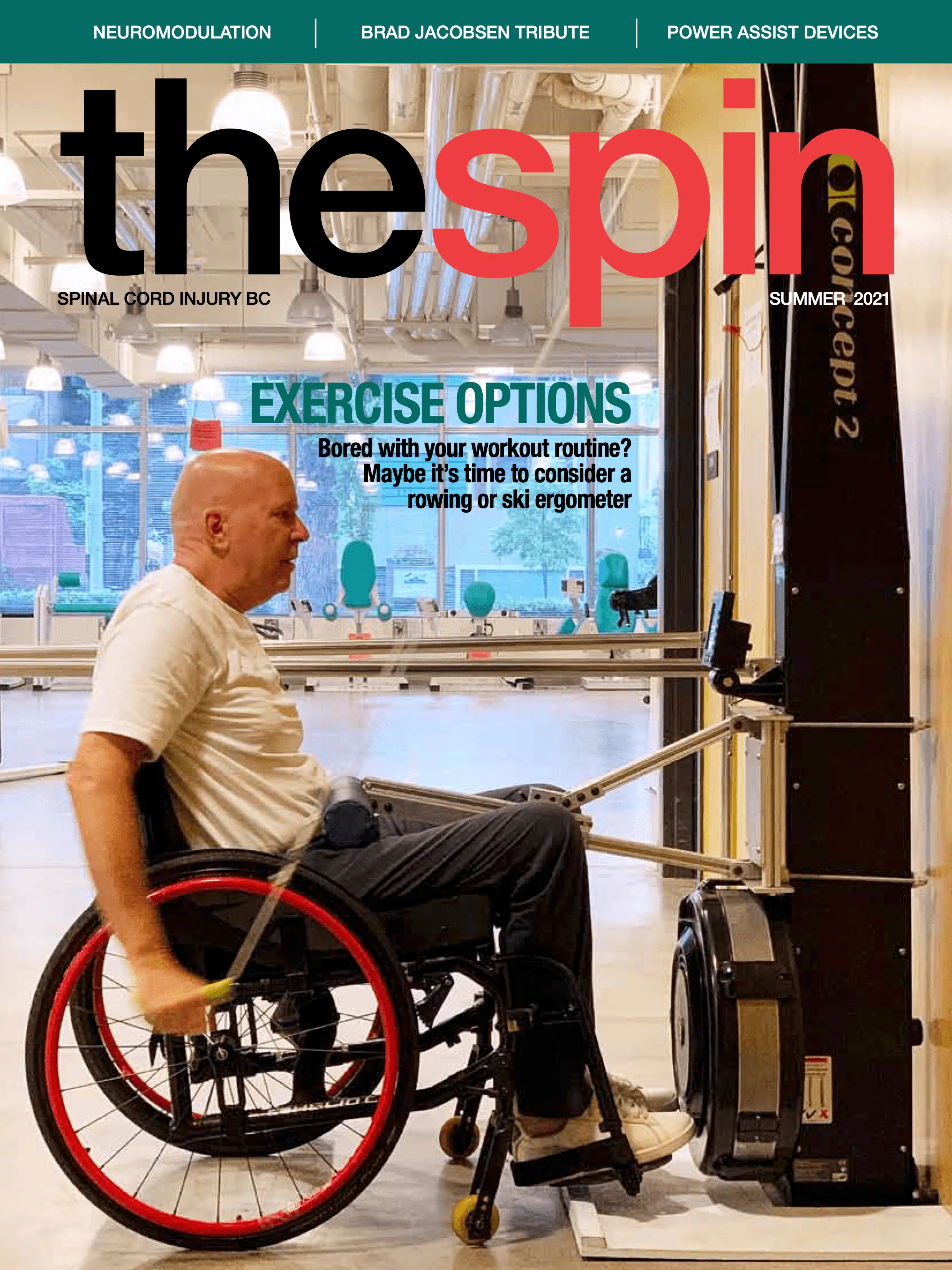
- Neuromodulation
- Alternative Exercise Options
- Access BC: Freedom to Roam
And more!


