
Fifty-five nations, 612 athletes, 79 events, six sports, four years of hard work, and one chance to be the best. For athletes who competed at the Milano Cortina 2026 Paralympic Winter Games, these numbers represent the daunting, high-pressure reality of the moment. What they don’t fully capture, however, is the 5 am wake up calls for practice in the dead of winter, weekends spent away from home, the complicated balancing act of managing responsibilities, and the grueling impact on the body in pursuit of being exceptional.
SCI BC peers Ina Forrest and Leo Sammarelli know first-hand the countless unseen moments of sacrifice and dedication that it takes to compete on the world stage. Forrest, a five-time medalist in wheelchair curling began her Paralympic pursuit in 2004, while Sammarelli, a first-time Paralympic athlete in cross country skiing, started his Para sport career in 2017. Despite the vast differences in their Paralympic journeys, Forrest and Samarelli’s unwavering commitment and joy for sport remains the same.
“Sports have always been a part of my life from a very young age,” Forrest says. Growing up in Fort St. John, she played volleyball and built her community through sports. “I always thought of myself as an athlete and figured I would always be doing something athletic for the rest of my life.” At 21, she was struck by an impaired driver while travelling to a volleyball tournament and sustained a T12 SCI. “After my accident, I couldn’t separate what I used to do from what I could do now and it took a long time for that to change.”


She stopped playing sports entirely and went on to graduate from university, get married, and start a family. It wasn’t until she moved to Spallumcheen, BC a rural township near Vernon, BC in 1998 that the possibility of being involved in sports entered her life again. “I was in Costco and this man came up to me and asked if I’d be interested in trying curling… Besides two experiences at a local bonspiel when I was a kid, I didn’t know anything about curling. It had never crossed my mind.”
Curious, Forrest probed for more information and learned that the man, Eric Eales, was an avid curler in the Okanagan who was trying to expand the relatively new sport of wheelchair curling in BC. As circumstances would have it, there was a curling Try-It day in Vernon shortly after their serendipitous meeting, and the stars aligned for Forrest to attend. “My son, the youngest of my three children, was just going into kindergarten and it felt like the right time. I was in a place in my life where I had some free time again and I had finally come around to the understanding that [sport] might be a little different now, but… feeling strong, capable, and being with people who share the same interests; that’s a very important thing.”
Forrest advanced quickly. She learned the sport under the guidance of Sharon Morrison (a lifelong curler who still coaches and plays with Forrest today) and went to Team BC tryouts just weeks after first rolling onto the pebbled ice sheets that would soon become her second home. Forrest made the Provincial team, then the National team, and was soon competing at a very high level on the Canadian four-person mixed team. “At the time, wheelchair curling was pretty new to Canada so you had the perfect mix of people who were really excited and interested in getting better, really good coaching, and a team to play on instantly. Everything kind of just fell into place,” she says.
Of course, there were setbacks. As a mother of three young children, a business owner with her husband, and a new Para athlete, the learning curve was steep—both in terms of the sport and personal experiences. “I hadn’t done anything remotely like this since having kids. It was a lot of time management and I was nervous about adjusting… when you’re a mom and you have to go away for a tournament and your little guy is crying at the door because you’re leaving, you start to feel bad about taking time for yourself. It was really hard,” Forrest recalls.
On top of these concerns were the ongoing challenges of travelling with a disability, inaccessible curling rinks, outdated facilities, a busy training schedule, and an ever-evolving strategic game to adapt to. “All the coaches that came into wheelchair curling came to the sport with an able-bodied strategy of how to curl. But because our game doesn’t have sweeping, because we’re in chairs and we don’t always throw big weights… their strategy need[ed] to change to suit our abilities. [At the same time], our abilities are getting better and the more we play, the more we can read the ice and there’s more shots available to us. The skill level worldwide is so much higher, and growing all the time. You have to make sure you keep up and that can be tough.”

Still, the happiness and friendship cultivated from curling motivated Forrest to keep coming back to the rink. Her hard work culminated in her first Paralympic appearance in 2010 in Vancouver. “I was so excited. My home country, my home province. I didn’t have any idea what to expect and I was really apprehensive about how I’d react,” she remembers. “We normally don’t have large crowds for our games and I was worried about stage fright. What if I get out there and can’t curl?” As it turns out, Forrest’s training and her team’s preparedness led them to a gold-winning performance in front of family and friends, and set the trajectory for a string of successful reappearances at the Sochi 2014 Games, where the four-person mixed wheelchair curling team captured gold again, and PyeongChang 2018 and Beijing 2022 where the team secured bronze.
As Forrest fulfilled her Paralympic dream, another one was just beginning. “Basically right out of rehab at G.F. Strong, I wanted to get back into sports,” Leo Sammarelli recounts. Growing up in Vancouver, Sammarelli was always active and pursued boxing from an early age, reaching national competition levels and training in Italy, where his father grew up. In 2017, he was a victim of gun violence that resulted in a T8 SCI and the direction of his athletic career—and his life—changed in a profound way. “My injuries were very extensive and I needed a lot of time to rebuild my body [but] training has always been a part of life so for me, it was about finding different ways to move and using sport as a tool for rehab.”
Sammarelli’s background in high-performance athletics naturally led to an interest in Para sport, and during the first year of his SCI recovery, he attended the Canadian Paralympic Committee’s Paralympian Search event at the Richmond Olympic Oval. The event was an open call for aspiring athletes to participate in a series of physical, agility, and strength-based tests with the prospect of being recruited by coaches for the Paralympics. “That’s where I met my coach and was first introduced into the Nordic Racers Club in North Vancouver,” Sammarelli says. “I had never skied before. Ever. The first time I went up I was very humbled… It’s not like a lot of sports where you can just grab a ball or paddle and play around. It requires a massive aerobic base to even get started.”
Determined to improve, he threw himself into the sport and went from not being able to finish a sprint distance to competing and medaling in the Canada Games. His training schedule increased to up to 20 hours of conditioning per week and two practices a day. Vancouver’s mild winters limited access to reliable training conditions, so most mornings, Sammarelli packed his car and drove to the North Shore mountains or Whistler, where good snow conditions were still never guaranteed. “Can you imagine [skiing] 20 kilometres and everything’s changing? The whole course is melting right under your skis as you go,” he laments. “Every race is a test within yourself, but it’s also a test within Mother Nature. It could be negative 30 outside one day and plus two the next. You’re dealing with the weather and your equipment and every course is different. You need to wax your skis for the conditions and rely on your pit crew and coaches. It’s a lot about the details. There’s no short cuts.”

For Sammarelli, this all or nothing approach is a strategy he also applied off the mountain. While pursuing skiing excellence, he returned to boxing and learned how to adapt his previous expertise to his SCI. He began teaching other people with SCI in his community and established weekly online adaptive boxing classes hosted by SCI BC. With a new, unique perspective on the sport, he helped create the first wheelchair adaptive boxing council in BC and now serves as a Director of Diversity and Inclusion for Boxing BC. He also currently coaches at the Rain City Boxing Club and Westcoast Wheelchair Adaptive Boxing in Vancouver.
“I’m the type of guy where I set goals and I make them happen. They’re not always realistic but that’s what I love about it,” he says. Beyond spearheading adaptive boxing, Sammarelli also became the first person to complete the Vancouver Marathon in a wheelchair, handcycled the Gran Fondo, and climbed the Grouse Grind on his hands. “Seeing how far I can go with the limitations of being in a wheelchair. I want to reach my full potential in this body and this new life. I like to push myself.”


In the 2025-26 season, Sammarelli set his sights on the Paralympics and entered the first eight races on the Para cross country skiing World Cup circuit to build his competitive ranking. Para nordic skiers compete in one of two classes: standing or sit-skiing, with a range of classifications (LW 2 to LW 12) within the two groups based on the athlete’s activity limitation and physical impairment.
Sammarelli is in the sit-skiing class with a classification of LW 10, which recognizes his SCI. “I’m racing against other people who have a lot more ability in terms of how they can move, how they can balance, and how they can maneuver the course on skis,” he explains. Moreover, many of his World Cup competitors lived in places where winter was at their doorsteps and training was easily accessible.
As he got closer to making his Paralympic dream a reality, Sammarelli had to contend with imposter syndrome. “I was the underdog,” he says. “There were a lot of ups and downs and thinking to myself, ‘Should I continue or not? Am I capable of competing and being faster than some of these guys?’” At the 2025 World Cup in Canmore, Alberta, Sammarelli quieted these thoughts with a performance that would earn him the last spot on the Canadian men’s Para Nordic skiing team and solidify his appearance at the upcoming Paralympics.
In March 2026, Forrest and Sammarelli both arrived in Italy to compete in the Milano Cortina Winter Paralympics. Forrest chasing gold in mixed wheelchair curling and Sammarelli racing in sit-ski cross-country events.
“It was almost like you had the same excitement for your first Games all over again,” says Forrest, whose most recent Paralympic appearance prior to Milano Cortina was during the height of the COVID-19 pandemic in Beijing. “I was so happy to have family and friends there again and it makes you realize how much they are part of the experience. At [my first] Paralympics in 2010 my kids were early teens or preteens and now they’re adults… it was really special having them [in Italy].” Supported by her family and friends, Forrest and her team went on to make history by completing an undefeated tournament run and winning gold. “You work so hard for four years and it’s pretty amazing to even have a chance at achieving something like this.”

Sammarelli’s experience in Milano Cortina also carried the weight of a full circle moment, despite it being his first time at the Games. “I’m Italian and I started my boxing career here. I can speak the language and I lived here so, in a way, it was like coming home. Everything felt like it lined up in some kind of destiny so that I was able to make it to the Games in Italy,” he says. While there, Sammarelli learned that his former boxing coach, who he trained with in Italy, had passed away. The emotion felt from his coach’s passing, coupled with the overwhelming atmosphere and expectations made for a very emotional experience. “We focus so much on our goal and arriving there… you put all your eggs in one basket that you’ve worked so hard for, but the journey there is just as special,” he says. “Being able to travel, meeting people, hearing their stories and learning about their experiences… I’m on a team with multiple-time Paralympians and it’s an honour and a blessing to be surrounded with such decorated people like that and take it all in.”
When asked about what comes next, Forrest and Sammarelli’s Paralympic paths diverge. Sammarelli is more determined than ever to make it to the podium. “Will you see me in sport? 100%. I would like to medal in something. There’s a lot of stuff that needs to be processed after years of basically dedicating all your time, all your effort, all your resources into this one thing, but a medal is in my future… I’m always going to be pushing the boundaries and sharing my story. I love opening people’s minds to things.”
In comparison, Forrest is contemplating what life might look like beyond sport. For now, she’s enjoying the summer and time spent with family on her property in the Okanagan while reflecting on all that curling has given her. “When you spend most of your time in the able-bodied world, you might have to say no to things or bow out of opportunities… but when you join Para sports, suddenly, it’s a totally different view of yourself. You’re with people who have the same abilities and the same experiences as you and it gives you a feeling of being competent because you’re with your peers. It’s about so much more than sports.”
Whatever they decide to pursue next, one thing is for sure, Forrest and Sammarelli are bringing the same Paralympic drive to whatever comes next.
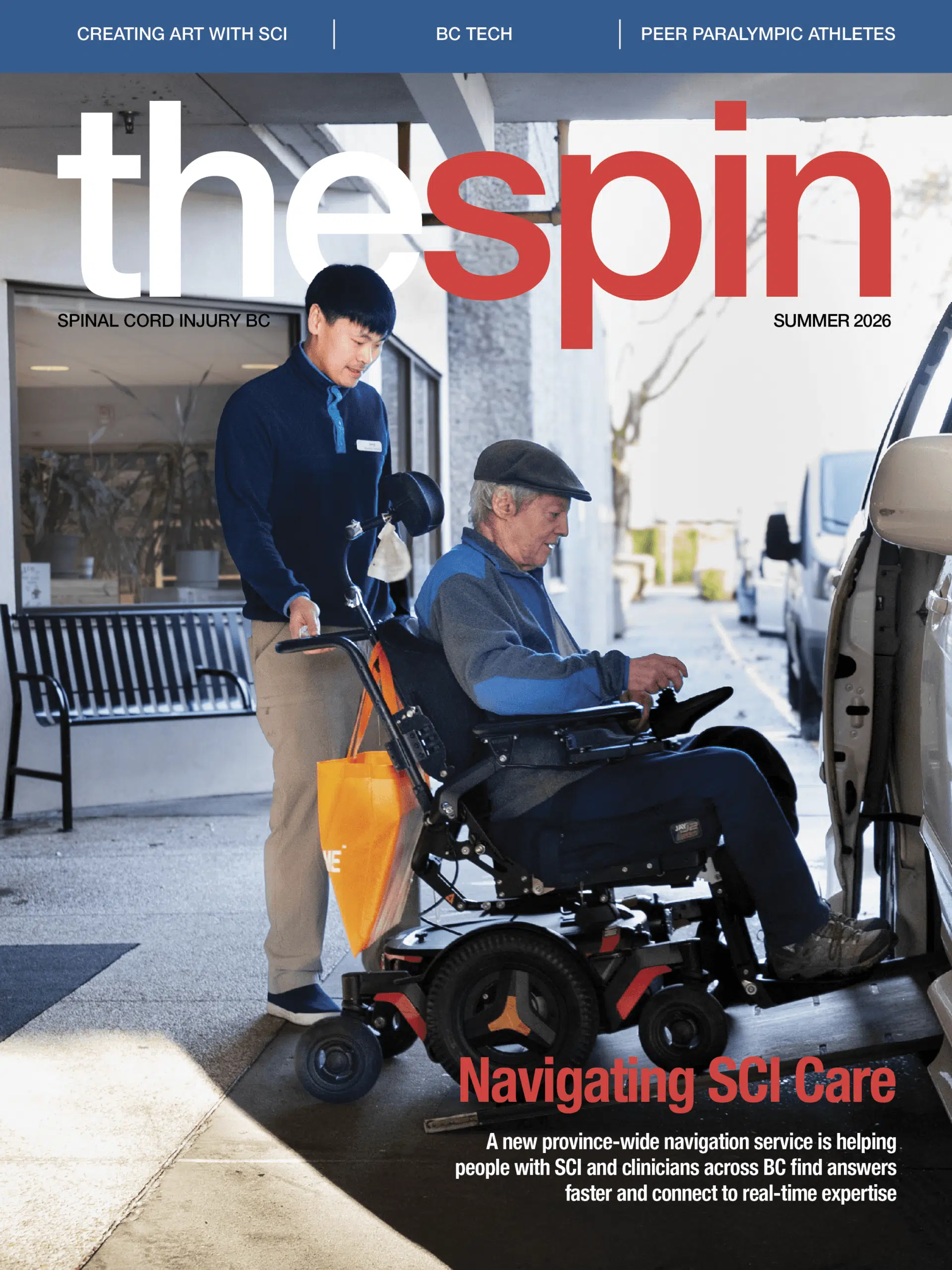
This article originally appeared in the Summer 2026 issue of The Spin. Read more stories from this issue, including:
- Creating art with SCI
- The new SCI Nav service
- BC tech
And more!


